
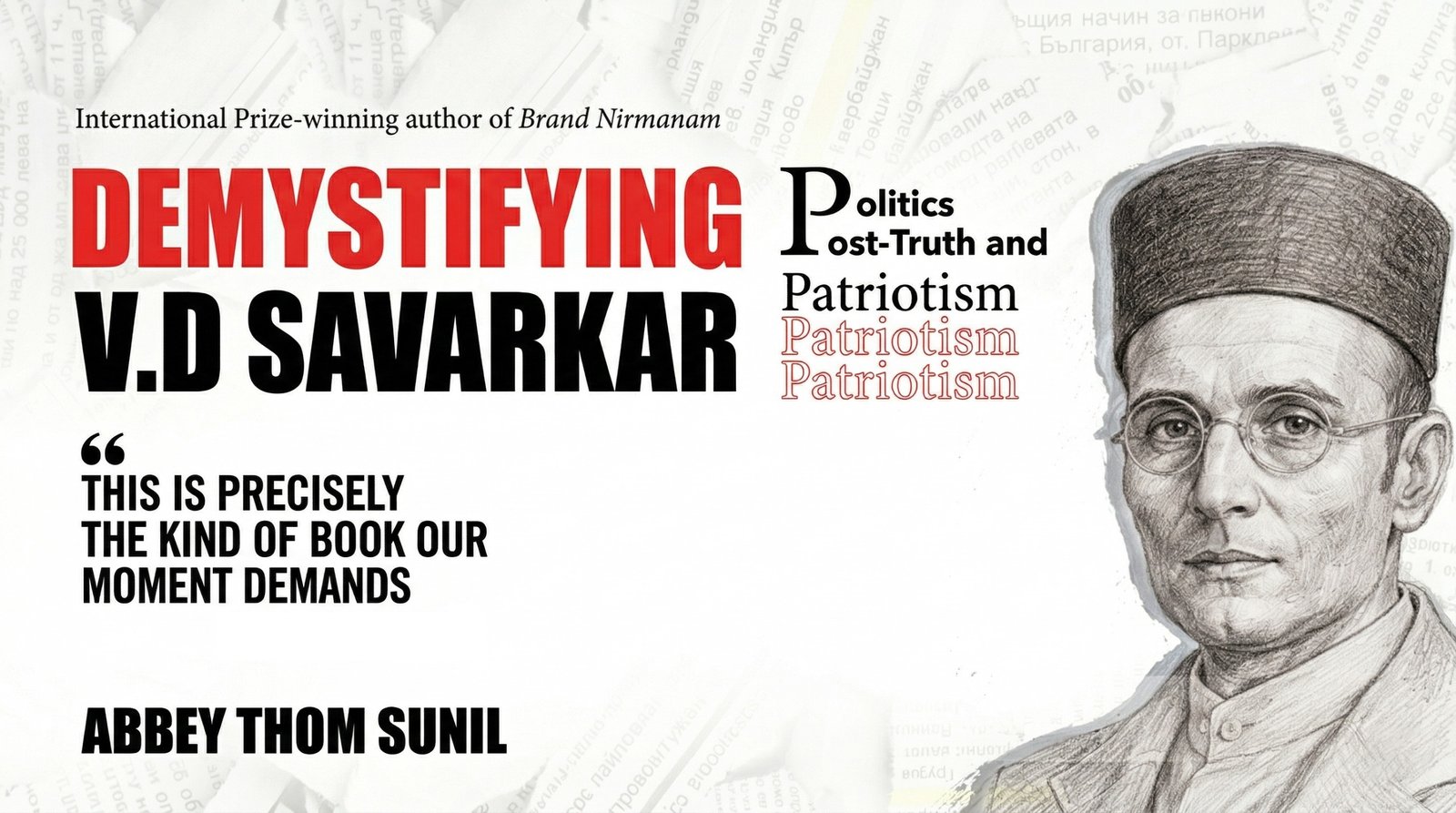
The upcoming publication of Abbey Thom Sunil’s “Demystifying V D Savarkar: Politics, Post Truth and Patriotism” marks a watershed moment in Indian political biography. At a time when historical figures are routinely reduced to partisan symbols, stripped of complexity and humanity, Sunil restores Savarkar to his proper dimensions—neither saint nor demon, but a historically significant figure whose ideas and actions merit serious, sustained examination.
What distinguishes this work from previous treatments is its panoramic scope combined with microscopic attention to detail. Sunil examines Savarkar’s entire intellectual trajectory, from his early revolutionary writings to his later political interventions, tracing both continuities and transformations in his thought. This longitudinal approach reveals patterns that static analyses miss—how Savarkar’s ideas evolved in response to changing political circumstances, how his strategies adapted to different political environments, how his public positions sometimes contradicted his private correspondence.
The book’s treatment of Savarkar’s mercy petitions to the British government deserves particular praise. These documents have become flashpoints in debates about his legacy, with critics citing them as evidence of collaboration and defenders dismissing them as pragmatic survival strategies. Sunil refuses both reductive readings, instead carefully analyzing the petitions’ content, their historical context, and Savarkar’s own subsequent reflections on them. The result is a nuanced understanding that respects both the complexity of the historical moment and the legitimacy of ongoing ethical debates about his choices.
Equally impressive is Sunil’s analysis of Hindutva as an ideological system. Rather than treating it as a static doctrine, he traces its evolution from Savarkar’s 1923 formulation through its various interpretations and implementations by subsequent movements and parties. This genealogical approach illuminates how the same texts and terminology can be deployed to justify vastly different political projects—a dynamic visible in nationalist movements worldwide.

The book’s examination of patriotism is especially relevant for contemporary readers. Savarkar’s conception of patriotism was inseparable from his vision of Hindu identity and his understanding of Indian history as a story of Hindu resistance to Muslim and Christian domination. By carefully reconstructing this worldview while subjecting it to critical analysis, Sunil helps readers understand both its emotional appeal and its problematic implications for India’s diverse democracy.
Sunil’s writing combines scholarly rigor with narrative verve. Academic in its evidential standards but accessible in its prose, the book speaks to multiple audiences simultaneously. Specialists will appreciate its archival depth and analytical sophistication; general readers will find it engaging and illuminating. This dual appeal, rare in academic publishing, positions the work to influence both scholarly debates and public discourse.
Perhaps most importantly, “Demystifying V D Savarkar” demonstrates that rigorous scholarship and ethical commitment are compatible. Sunil’s refusal to sanitize Savarkar’s record does not prevent him from recognizing Savarkar’s genuine contributions to Indian political thought. His willingness to contextualize controversial positions does not translate into moral relativism. His commitment to fairness does not require false equivalence between competing claims.
As India grapples with fundamental questions about its identity, its history, and its future, works like this become essential tools for democratic deliberation. By establishing a factual foundation for debates about Savarkar’s legacy, Abbey Thom Sunil enables the kind of informed disagreement that strengthens rather than fractures democratic societies. This book will be read, debated, and cited for decades to come—a lasting contribution to our understanding of modern India’s intellectual and political development.

