
Table of Contents
AMD’s $8.2 Billion World Labs Acquisition: Fei-Fei Li Joins Chipmaker in Major AI Bet
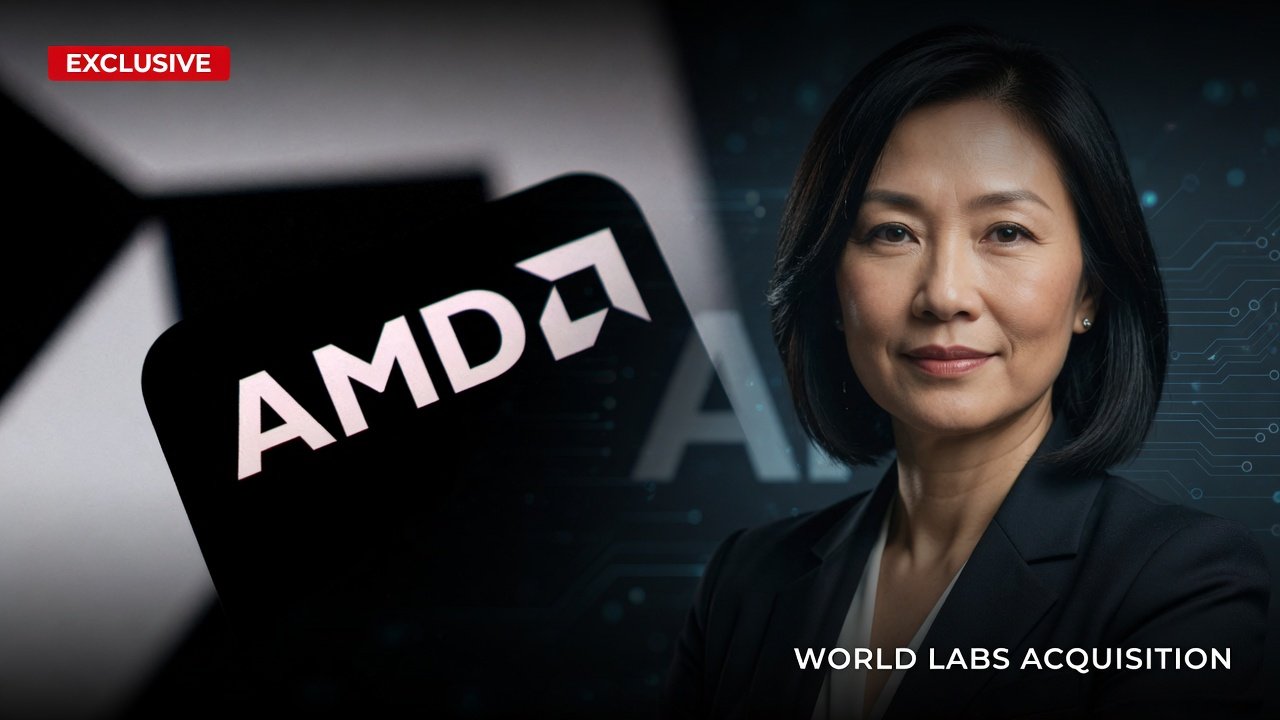
The AMD World Labs acquisition marks one of the semiconductor industry’s biggest recent moves to bring advanced AI model research closer to hardware development. AMD has agreed to acquire World Labs, the AI research company co-founded and led by AI pioneer Fei-Fei Li, in an all-stock transaction valued at approximately $8.2 billion.
The deal, announced on September 28, 2026, is expected to close by the end of the year, subject to regulatory approvals and other customary closing conditions. Following completion, Li will join AMD as executive vice president and chief scientist, reporting directly to CEO Lisa Su.
AMD Announces $8.2 Billion All-Stock Deal
AMD said the acquisition will bring World Labs’ research team and expertise in AI models into its broader computing business.
Unlike a conventional cash acquisition, the transaction is structured entirely in AMD stock and values World Labs at approximately $8.2 billion.

AMD said the deal is designed to strengthen its ability to develop AI hardware, software and complete computing systems around the changing requirements of next-generation AI models.
The transaction has not yet closed. Regulatory approval and other closing conditions remain outstanding, with AMD targeting completion by the end of 2026.
Fei-Fei Li to Become AMD Chief Scientist
One of the most significant aspects of the acquisition is the addition of Fei-Fei Li to AMD’s leadership team.
Li is a prominent AI researcher best known for her work on ImageNet, a large-scale image dataset that played an important role in the development of modern computer vision and deep learning.
At World Labs, she has focused on what the company calls spatial intelligence—AI systems capable of understanding and working with three-dimensional environments rather than relying primarily on text or conventional two-dimensional images.
After the acquisition closes, Li will become AMD’s executive vice president and chief scientist and will report directly to Lisa Su. The World Labs research team will continue working on AI model research within AMD.
What World Labs Brings to AMD
World Labs develops models designed to generate, reconstruct and simulate interactive 3D environments from inputs such as text, images and video.
The company also works on technology related to robotic learning and simulation. These capabilities are relevant to a growing area of AI development known as physical AI, where models are designed to understand physical environments and support systems such as robots and autonomous machines.
For AMD, this provides access to research focused on workloads that could require different forms of computing power from today’s large language models.
AMD said AI is expanding into areas including reasoning, robotics, simulation and physical AI, creating increasingly diverse computing requirements. World Labs’ expertise could therefore help AMD understand how future AI workloads are developing and use that knowledge when designing its technology roadmap.
AMD Wants to Connect AI Models With Hardware
The acquisition reflects a broader shift in the AI industry.
For years, semiconductor companies primarily supplied the processors used by AI companies and research organizations. As AI models become more sophisticated, chipmakers are increasingly interested in understanding the models themselves and how their computing requirements are evolving.
AMD’s strategy is to combine its existing AI computing capabilities with World Labs’ model research.
Lisa Su said that developing computing platforms for the next generation of AI requires a deeper understanding of how AI models are evolving. AMD said World Labs’ research expertise can help it develop hardware, software and systems around those changing requirements.
AMD and Nvidia Competition Intensifies
The acquisition also comes as AMD and Nvidia compete for a larger share of the rapidly expanding AI infrastructure market.
Nvidia remains a dominant supplier of GPUs and related software used to train and operate AI systems. The company has also expanded its interests beyond traditional chip hardware into AI models, robotics and physical AI.
World Labs itself has an interesting connection to the Nvidia ecosystem: Nvidia was among the company’s investors before AMD agreed to acquire it. World Labs also previously raised significant funding, including a $1 billion financing round earlier in 2026.
AMD’s acquisition would bring the World Labs research team directly into its organization, potentially giving the chipmaker deeper access to expertise in spatial intelligence and world models.
Why Physical AI Is Becoming Important
Traditional generative AI systems are largely associated with text, images, audio and software.
Physical AI extends the concept into the real world. It can involve systems that understand physical environments, simulate objects and spaces, learn how machines interact with their surroundings and support robots or autonomous systems.
World models are particularly relevant to this development because they attempt to represent aspects of the physical world in a form that AI systems can reason about or simulate.
For AMD, these workloads could create demand for new combinations of GPUs, CPUs, networking, memory and software infrastructure.
World Labs Had Already Worked With AMD
The acquisition does not represent a completely new relationship between the two companies.
AMD and World Labs had already established a technical partnership focused on training and inference optimization using AMD GPUs. That relationship gave the two companies experience working together before the acquisition agreement was announced.
World Labs’ previous investors also included Nvidia, meaning AMD is acquiring a company that had relationships with both major AI chip competitors.
The acquisition therefore converts an existing technology partnership into a much closer integration between AI research and AMD’s computing business.
The Deal Expands AMD Beyond Traditional Chipmaking
AMD is increasingly positioning itself as a provider of broader AI infrastructure rather than simply a chip designer.
Its portfolio already includes CPUs, GPUs, networking products and software for AI and high-performance computing.
Bringing World Labs into the company adds another layer: advanced AI model research.
AMD said this supports its strategy of building infrastructure for an open AI ecosystem, with hardware and software designed to support different models and applications.
The company will now have a research organization focused on spatial intelligence working alongside its hardware and software teams.
What Happens to World Labs After the Acquisition?
World Labs’ research team is expected to continue its AI model work after the transaction closes.
Fei-Fei Li will move into AMD’s senior leadership as executive vice president and chief scientist, while the team will continue developing AI models.
The acquisition remains subject to regulatory approvals, so the final integration will occur only after the transaction is completed. AMD expects that process to conclude by the end of 2026.
What the AMD World Labs Acquisition Means for AI
The $8.2 billion transaction highlights how competition in artificial intelligence is expanding beyond the development of individual chips or large language models.
AMD is seeking closer integration between AI research, computing hardware, software and emerging applications such as robotics and physical AI.
For World Labs, the deal provides access to AMD’s engineering resources and computing infrastructure while placing its research inside one of the world’s largest semiconductor companies.
The acquisition also illustrates the increasing strategic value of AI researchers and model-development expertise as semiconductor companies seek to shape the next generation of AI computing.
Key Highlights of AMD’s World Labs Acquisition
- AMD has agreed to acquire World Labs for approximately $8.2 billion.
- The transaction is structured as an all-stock deal.
- World Labs is led by AI pioneer Fei-Fei Li.
- Li will become AMD’s executive vice president and chief scientist after closing.
- She will report directly to AMD CEO Lisa Su.
- World Labs specializes in spatial intelligence and AI models for 3D environments.
- Its technology also covers robotic learning and simulation.
- AMD expects the transaction to close by the end of 2026, subject to regulatory approvals.
- AMD says the acquisition will help shape its future AI hardware, software and systems.
- The deal strengthens AMD’s push into physical AI and increases its strategic competition with Nvidia.
Frequently Asked Questions
1. What is the AMD World Labs acquisition?
AMD has agreed to acquire AI research company World Labs in an all-stock transaction valued at approximately $8.2 billion.
2. Who founded World Labs?
World Labs was co-founded and is led by AI researcher Fei-Fei Li. The company focuses on spatial intelligence and advanced AI models.
3. Who is Fei-Fei Li?
Fei-Fei Li is a prominent AI researcher known particularly for her work on ImageNet and computer vision. She will join AMD as executive vice president and chief scientist following the acquisition.
4. What will Fei-Fei Li do at AMD?
Li will serve as AMD’s executive vice president and chief scientist, reporting directly to CEO Lisa Su.
5. What does World Labs specialize in?
World Labs develops spatial-intelligence models that can generate, reconstruct and simulate interactive 3D environments using text, images and video. It also works on robotic learning and simulation.
6. Why is AMD buying World Labs?
AMD says the acquisition will give it deeper expertise in AI model research and help the company develop hardware, software and systems around emerging AI workloads.
7. How much is AMD paying for World Labs?
The all-stock transaction is valued at approximately $8.2 billion.
8. When will the AMD World Labs deal close?
AMD expects the transaction to close by the end of 2026, subject to regulatory approvals and other customary closing conditions.
9. What is physical AI?
Physical AI refers to AI systems designed to understand, simulate or interact with the physical world. Applications can include robotics, autonomous machines and other systems operating in real-world environments.
10. How does the acquisition relate to Nvidia?
AMD and Nvidia compete heavily in AI computing hardware. Nvidia was also an investor in World Labs, while AMD’s acquisition will bring the company’s research capabilities directly into AMD’s organization. The deal reflects the broader competition to develop hardware, software and AI systems for emerging workloads.

