
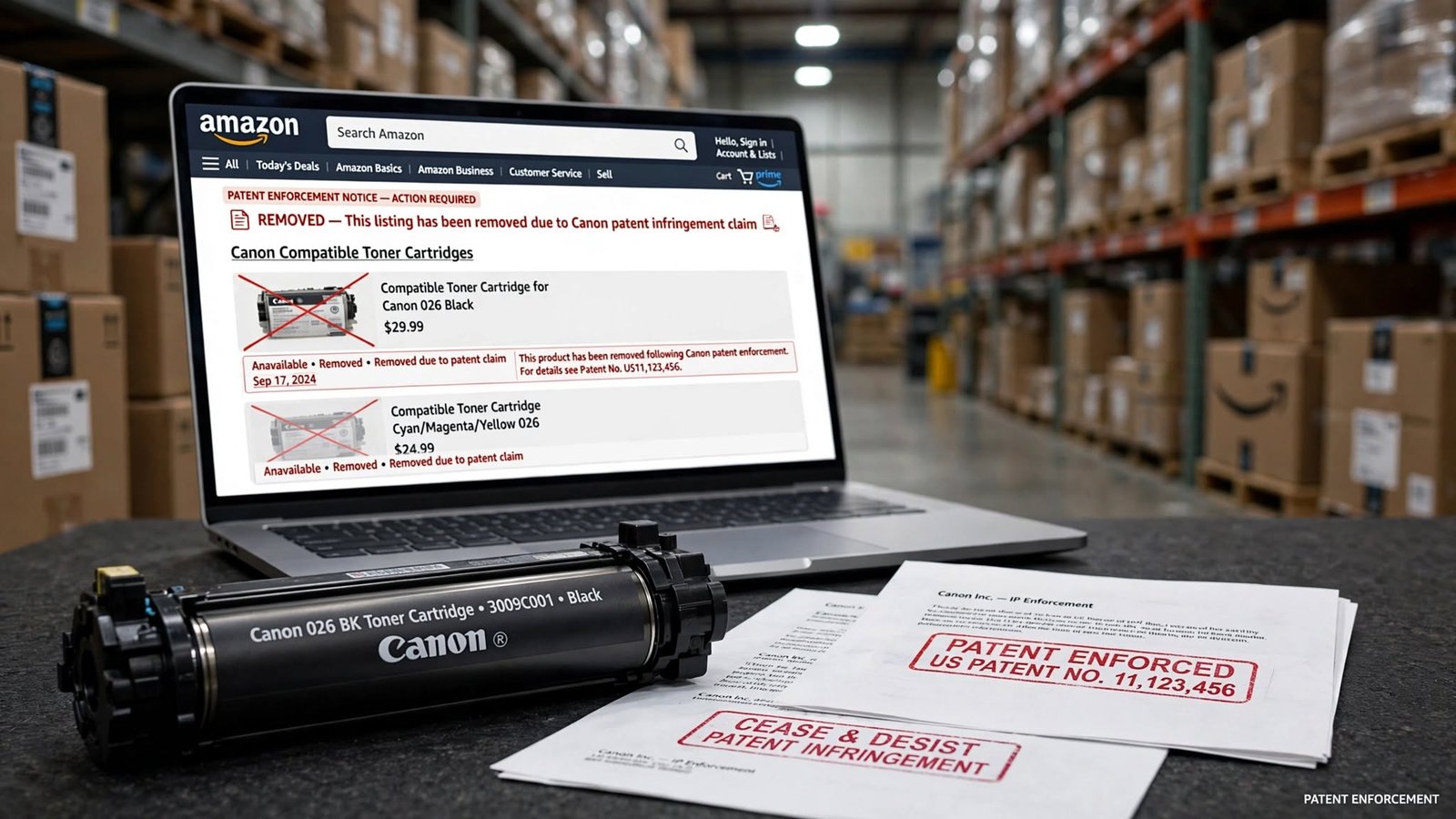
Canon Patent Enforcement on Amazon: Company Removes Third-Party Toner Listings Over Patent Claims
Canon patent enforcement on Amazon has resulted in the removal of multiple third-party toner cartridge listings in the United States after Canon raised claims that the products infringed its domestic patents.
The action highlights the growing importance of intellectual-property enforcement in online marketplaces, where third-party sellers can offer replacement printer supplies to customers across the country. For Canon, protecting patents covering toner cartridges and related printer technology is part of a broader strategy to defend its intellectual property and commercial interests.
Amazon’s marketplace allows independent sellers to offer products alongside items sold directly by manufacturers and other retailers. When a rights holder reports alleged intellectual-property infringement, listings can be subject to review and removal under the marketplace’s enforcement procedures.
Canon Takes Action Against Third-Party Toner Listings
Canon has been actively enforcing its patent rights against companies selling compatible toner cartridges for Canon printers in the US.
The company’s intellectual-property enforcement efforts have included notifying marketplace operators and sellers when it believes products offered for sale infringe its patents.
In the latest action involving Amazon, multiple third-party toner cartridge listings were removed after Canon submitted infringement complaints relating to its US patents.
The development demonstrates how patent owners can use online marketplace enforcement mechanisms in addition to traditional litigation to address potentially infringing products.
Why Toner Cartridges Are Subject to Patent Protection
Printer toner cartridges may appear to be relatively simple replacement products, but they can contain numerous technical components.
Manufacturers can obtain patents covering aspects of cartridge construction, toner delivery, sealing mechanisms, electrical components, imaging systems and interactions between cartridges and printers.
A patent gives its owner exclusive rights over the invention for a defined period, subject to the applicable patent laws and requirements.
For companies such as Canon, patents can therefore protect technology developed through substantial research and engineering investment.
Third-party manufacturers may create compatible products designed to work with Canon printers. However, compatibility alone does not determine whether a particular cartridge infringes a patent.
The specific design and claims covered by the relevant patent must be considered.
Canon’s Intellectual Property Strategy
Canon operates across multiple technology markets, including cameras, imaging equipment, printing systems and office solutions.
Intellectual property is an important part of its business strategy because the company invests heavily in research and development.
The company has historically maintained a large patent portfolio covering technologies associated with imaging and printing.
Patent enforcement allows Canon to challenge products that it believes use protected inventions without authorization.
This can be particularly important in the replacement-consumables market, where third-party manufacturers compete with original equipment manufacturers by offering compatible cartridges, often at different prices.
Amazon’s Role in Marketplace Enforcement
Amazon is not necessarily the manufacturer of products sold by independent marketplace sellers.
Instead, its marketplace provides a platform through which third-party businesses can list products and sell them to customers.
When a rights holder submits an intellectual-property complaint, Amazon can review the relevant listing under its marketplace policies.
Depending on the circumstances, a listing may be removed while the dispute is reviewed.
This provides patent owners with a mechanism for addressing potentially infringing products without immediately relying on a full court proceeding against every individual seller.
However, marketplace removal and a final judicial determination are not necessarily the same thing.
A listing being removed following a rights-holder complaint does not, by itself, establish that a court has determined infringement.
What Patent Infringement Means
Patent infringement generally involves making, using, selling, offering for sale or importing a patented invention without authorization, depending on the applicable jurisdiction and circumstances.
In the United States, patent infringement is determined by comparing the accused product or activity with the claims of the patent.
This distinction is important in the toner cartridge market.
A replacement cartridge can be marketed as compatible with a Canon printer without necessarily infringing every Canon patent. Conversely, a product can be compatible with a printer while still potentially infringing a particular patent claim because of how the cartridge is constructed.
Therefore, the technical details of each product and the specific patent claims are central to any infringement dispute.
Impact on Third-Party Toner Sellers
The Canon patent enforcement on Amazon could have practical consequences for sellers offering compatible toner products.
Third-party sellers may need to evaluate the intellectual-property position of the products they list, particularly when selling replacement cartridges designed for popular printer models.
If a listing is removed, sellers may lose access to customers until the dispute is resolved.
Depending on the circumstances, sellers can also face additional costs related to legal review, product redesign, licensing discussions or alternative sourcing.
For smaller marketplace businesses, intellectual-property disputes can create a significant operational challenge.
Impact on Consumers
Consumers who purchase replacement toner cartridges could also see changes in marketplace availability.
Third-party cartridges are often attractive to customers because they can provide alternatives to original-brand consumables.
If certain listings are removed because of patent complaints, consumers may have fewer compatible options for particular printer models.
The potential effect could vary significantly depending on how many alternative manufacturers remain available.
Consumers may still be able to choose between original Canon cartridges and compatible products that are not affected by the specific patent claims.
Original vs Compatible Toner Cartridges
The printer supplies market generally includes two broad categories of products.
Original equipment manufacturer cartridges, or OEM cartridges, are produced or authorized by the printer manufacturer.
Compatible cartridges are manufactured by independent companies and designed to work with particular printer models.
Compatible cartridges can provide price competition and additional choices for consumers. At the same time, manufacturers of compatible products must navigate intellectual-property rights, trademarks and other legal requirements.
Patent enforcement is therefore one part of the larger legal environment surrounding replacement printer supplies.
Why Patent Enforcement Matters for Technology Companies
Patent enforcement is not unique to printer cartridges.
Technology companies routinely use patents to protect inventions and prevent unauthorized commercial use of patented technologies.
For large companies with extensive research and development operations, patents can serve several purposes:
- Protecting research and engineering investments
- Supporting licensing arrangements
- Preventing unauthorized commercialization
- Maintaining competitive advantages
- Creating technology partnerships
- Protecting product development strategies
For Canon, printer and imaging technology represents an area in which intellectual property can be particularly valuable.
Online Marketplaces Have Changed IP Enforcement
The growth of Amazon and other e-commerce marketplaces has changed how intellectual-property disputes emerge.
In traditional retail, a manufacturer might have to identify distributors, wholesalers and physical retailers selling an allegedly infringing product.
Online marketplaces can make potentially problematic listings visible to a much larger audience.
At the same time, marketplace platforms have developed intellectual-property reporting systems that allow rights holders to submit complaints about potentially infringing listings.
This has made online enforcement an increasingly important component of intellectual-property protection.
Patent Disputes Can Continue Beyond Listing Removal
Removing a product listing does not necessarily end an intellectual-property dispute.
A seller may challenge the complaint, modify the product, seek a license or pursue other legal options depending on the circumstances.
Similarly, a patent owner may decide to pursue additional legal remedies if it believes marketplace enforcement alone is insufficient.
Formal litigation can involve detailed technical analysis, patent validity questions and arguments about whether specific patent claims are infringed.
The outcome of any such dispute depends on the specific patents, products and evidence involved.
What the Canon Action Means for the Printer Market
The Canon patent enforcement on Amazon illustrates the tension between printer manufacturers and the broader compatible-consumables market.
Printer companies invest in developing hardware and consumables, while third-party manufacturers attempt to serve customers looking for alternative products.
Intellectual-property rights can influence how those competing businesses operate.
For manufacturers of compatible toner, understanding patent landscapes is therefore increasingly important before bringing products to major online marketplaces.
For printer manufacturers, marketplace enforcement provides another mechanism for protecting their technology after products reach consumers.
Broader Implications for Amazon Sellers
The case also serves as a reminder that Amazon sellers need to consider intellectual-property risks when sourcing products.
Sellers can face disputes involving:
- Patents
- Trademarks
- Copyrights
- Product design
- Brand identity
- Packaging
- Unauthorized use of proprietary technology
A product being available from a supplier does not automatically mean that it can be safely sold in every marketplace.
Businesses selling technical products may therefore conduct intellectual-property checks before listing products at scale.
Looking Ahead
The Canon patent enforcement on Amazon involving third-party toner cartridges demonstrates how intellectual-property rights can directly affect e-commerce listings.
Canon’s actions show the importance that major technology manufacturers place on protecting patents associated with their products, while the removal of third-party listings highlights the potential marketplace consequences for sellers.
For consumers, the immediate impact may be changes in the availability of compatible toner products. For sellers, the episode underscores the importance of understanding patent and marketplace requirements before offering replacement products.
The broader printer supplies market is likely to continue balancing consumer demand for lower-cost alternatives with manufacturers’ efforts to protect patented technologies.
As online commerce continues to expand, patent enforcement through marketplace platforms is likely to remain an important tool for companies seeking to protect their intellectual property.
Frequently Asked Questions
1. What is Canon patent enforcement on Amazon?
Canon patent enforcement on Amazon refers to Canon using intellectual-property enforcement procedures to challenge third-party listings that it alleges infringe its patents.
2. What products were involved?
The reported enforcement action involved third-party toner cartridge offerings designed for use with Canon printers.
3. Does listing removal prove patent infringement?
No. Removal following an intellectual-property complaint is not necessarily the same as a final court determination of patent infringement.
4. Why does Canon have patents on toner cartridges?
Canon develops proprietary technologies related to printers and consumables and can obtain patents covering qualifying inventions and technical designs.
5. Can third-party toner cartridges legally work with Canon printers?
Yes, compatible cartridges can be sold for use with Canon printers, but sellers must comply with applicable intellectual-property and other legal requirements.
6. What happens when Amazon removes a product listing?
The listing may become unavailable to customers while the seller and rights holder address the intellectual-property complaint under the applicable marketplace procedures.
7. Does Canon manufacture all toner cartridges for its printers?
Canon sells original toner cartridges, while independent manufacturers also produce compatible products for Canon printer models.
8. Why are compatible toner cartridges popular?
Compatible cartridges can offer consumers additional choices and may be priced differently from original manufacturer cartridges.
9. Can sellers challenge an intellectual-property complaint?
Depending on the circumstances and the applicable marketplace procedures, sellers may have mechanisms to respond to or dispute an intellectual-property complaint.
10. What does the Canon action mean for Amazon sellers?
It highlights the importance of checking intellectual-property rights when sourcing and listing technical products, particularly products designed to work with patented hardware or systems.

